

Grafts
Skin Grafts at BayMed Medical Centre & Skin Cancer Clinic
Sometimes, removing a skin cancer or larger lesion leaves an area that can’t be closed easily with stitches alone. In these cases, a skin graft may be used to help cover the wound and support healing. At BayMed Medical Centre & Skin Cancer Clinic in Cheltenham, our doctors perform skin grafts under local anaesthetic for selected skin cancer excisions and other lesions where grafting is the most practical option.
We provide skin graft procedures for patients from Cheltenham, Mentone, Highett, Moorabbin, Hampton, Sandringham, Beaumaris and the wider Bayside and south-east Melbourne areas, as well as patients who travel from across Victoria for skin cancer checks and treatment at our Cheltenham clinic.
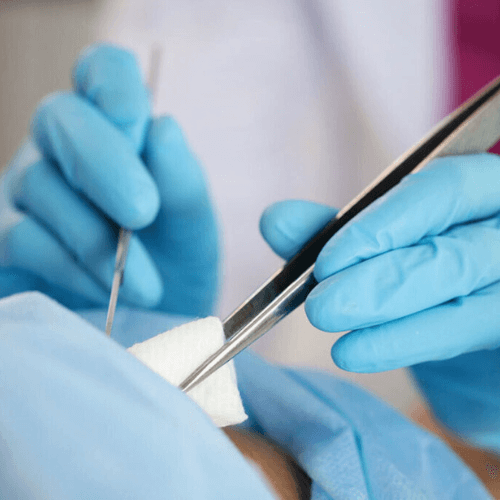
What Is a Skin Graft?
A skin graft is a small piece of healthy skin taken from one area of the body (the donor site) and placed over a wound in another area (the graft site).
The graft:
- Helps close and protect a wound that is too large or tight to stitch directly
- Supports healing and coverage after a wider skin cancer excision
- Can improve function and appearance compared with leaving a large wound to heal on its own
The donor site is usually chosen from a place where the scar will be less noticeable and the skin type is a good match.
When Might a Skin Graft Be Recommended?
Your BayMed doctor may suggest a skin graft when:
- A skin cancer excision has removed a larger area of skin, particularly on the face, scalp, lower legs or other tight areas
- Direct closure with stitches would overly distort nearby structures (such as the eyelid, nose or lip)
- Healing by secondary intention (letting the wound heal on its own) is likely to be too slow or uncomfortable
In some situations, your doctor may also consider local flap techniques instead of a graft. The choice depends on the size, depth and location of the wound and your individual circumstances.
Types of Skin Grafts
For small to moderate wounds in a clinic setting, the two main categories are:
- Split-thickness skin grafts – where a thin layer of the top skin is taken from the donor area. These can cover relatively larger surfaces and usually heal well at the donor site.
- Full-thickness skin grafts – where the full thickness of the skin is taken from a small donor area. These can provide a closer match in colour and texture for certain areas, such as parts of the face, but require careful planning and closure of the donor site.
Your BayMed doctor will explain which approach is most appropriate for your wound, or whether you should be referred to another specialist service for more complex reconstruction.
Planning for a Skin Graft
Before a graft is booked, your doctor will:
- Review your medical history, medications and any factors that may affect healing (such as circulation problems, diabetes or smoking)
- Examine both the planned graft site and potential donor sites
- Explain the procedure, expected scarring and recovery for both areas
- Discuss alternatives (such as direct closure or healing without grafting) where reasonable
- Let you know if you need to adjust any medications or activities around the time of surgery
You’ll also be told how long the appointment is likely to take and what support you may need afterwards.
What Happens During a Skin Graft Procedure?
Most straightforward grafts at BayMed are performed in our treatment room under local anaesthetic.
A typical procedure includes:
- Anaesthetic and Preparation
The graft site and donor site are cleaned and numbed with local anaesthetic. You may feel brief stinging as the anaesthetic is injected, then pressure but no sharp pain. - Excision and Wound Preparation
If the graft is part of a skin cancer excision, the lesion and a margin of surrounding skin are removed first. The wound edges are then shaped to provide a healthy bed for the graft. - Taking the Graft
A piece of skin is gently removed from the donor area. The size and thickness depend on the type of graft being used. - Placing and Securing the Graft
The graft is carefully placed over the wound and secured, often with fine stitches and a firm dressing or bolster to hold it in position while it attaches. - Closing the Donor Site
The donor area is either stitched closed or dressed to heal, depending on the type and size of graft taken. - Dressing and Instructions
Both sites are covered with dressings, and you’ll receive written and verbal instructions about how to care for them and what activities to avoid while the graft is healing.
Recovery and Healing After a Skin Graft
Healing after a graft involves two areas: the graft site and the donor site.
Your doctor will explain:
- How long to keep dressings in place and when they will be changed
- How to protect the graft from movement, pressure or trauma in the early stages
- When you can safely shower, return to work and resume exercise
- What to expect as the graft settles in colour and texture over time
You may notice:
- Bruising or swelling around the graft
- Changes in skin colour at both the graft and donor sites
- Mild discomfort or tightness as healing progresses
You’ll be advised what is normal and when to contact the clinic—for example, if you see increasing redness, pain, discharge or signs that the graft is not taking as expected.
Scarring and Cosmetic Outcome
All grafts leave a scar at both the graft site and the donor site. Your doctor will:
- Outline where the scars will be and what they are likely to look like
- Discuss measures to support good healing, such as sun protection, moisturising and scar care once healing allows
- Explain that grafts can sometimes be lighter, darker or slightly different in texture compared with surrounding skin
In many cases, the main priority is effective skin cancer treatment, with cosmetic considerations balanced alongside safety and function.
Is a Skin Graft Always Necessary?
A graft is not always required after a skin excision. Depending on the wound and its location, your doctor may instead recommend:
- Direct closure with stitches
- Local flap reconstruction
- Allowing the wound to heal on its own in a controlled way, where appropriate
Your BayMed doctor will talk through the realistic options for your situation and help you decide which approach fits your medical needs, lifestyle and preferences.
Book a Skin Graft Consultation in Cheltenham
If you’ve been advised that you may need a skin graft as part of a skin cancer excision or other procedure, you can book a Skin Cancer Clinic appointment at BayMed Medical Centre & Skin Cancer Clinic in Cheltenham.
Bookings can be made online or by calling our reception team. Please mention that you’ve been told you may need a skin graft, so we can allocate enough time to assess your lesion, discuss reconstruction options and plan the procedure that best suits your case.