
Living in Melbourne’s Bayside area means spending plenty of time outdoors, whether that is at the beach, walking, playing sport or simply enjoying the warmer months. Over time, sun exposure can affect the skin and increase the importance of knowing what changes to look out for.
If you live in Cheltenham, Sandringham or surrounding Bayside suburbs, a skin cancer check can help assess suspicious spots, changing moles and other areas of concern.
At BAYMED Medical Centre & Skin Cancer Clinic in Cheltenham, our doctors provide skin checks, dermoscopy, mole monitoring and selected skin cancer treatments for patients from Cheltenham, Sandringham, Highett, Hampton, Beaumaris, Black Rock and nearby areas.
Learn more about our Skin Cancer Clinic in Cheltenham and near Sandringham
What Is a Skin Cancer Check?
A skin cancer check involves examining the skin for moles, spots or lesions that may require closer assessment.
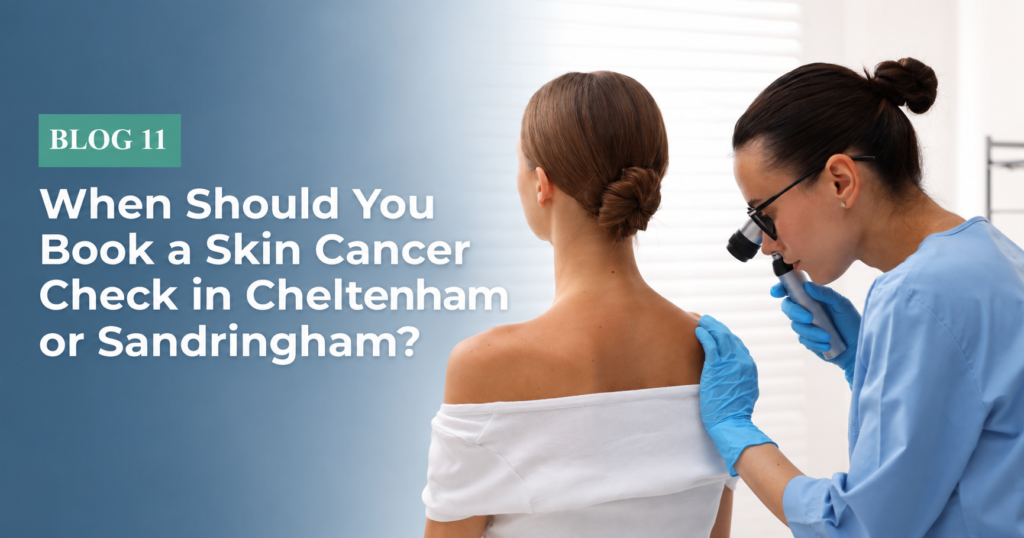
Depending on your individual circumstances, your doctor may examine your entire skin surface or focus on a particular area of concern. Dermoscopy may also be used to look at individual lesions under magnification.
If a spot appears unusual, your doctor may recommend monitoring it, taking digital images, performing a biopsy or discussing appropriate treatment options.
Signs That You Should Have a Spot Checked
It is worth booking an appointment if you notice a mole or skin lesion that:
- Has recently appeared
- Is changing in size, shape or colour
- Has an irregular border
- Looks different from your other moles
- Bleeds, crusts or repeatedly becomes irritated
- Does not appear to heal
- Becomes painful, itchy or tender
- Changes in elevation or texture
Not every changing spot is skin cancer, but new or unusual changes should be assessed by a healthcare professional rather than self-diagnosed.
What Does the ABCDE Rule Mean?
The ABCDE rule is commonly used as a simple guide for changes that may warrant closer examination.
A – Asymmetry
One half of a mole may look different from the other half.
B – Border
The edges may appear irregular, uneven or poorly defined.
C – Colour
The spot may contain different shades or show a noticeable colour change.
D – Diameter
Larger lesions may warrant assessment, although skin cancers can also be small.
E – Evolving
Any noticeable change in size, shape, colour, texture or symptoms should be considered.
The ABCDE guide is useful, but it cannot replace a professional skin assessment.
Who May Benefit From Regular Skin Checks?
Some people may be advised to have their skin checked more regularly depending on their personal risk factors.
These can include:
- A previous history of skin cancer
- A family history of melanoma or other skin cancers
- Significant lifetime sun exposure
- Frequent sunburn, particularly earlier in life
- Fair skin that burns easily
- A large number of moles
- Unusual or atypical-looking moles
- Outdoor work or frequent outdoor activities
- A weakened immune system
Your doctor can discuss how often skin checks may be appropriate based on your individual history.
What Happens During a Skin Check?
During your appointment, your doctor will review any areas that concern you and examine your skin for spots that may require closer attention.
A dermatoscope may be used to magnify the structures within a lesion that cannot easily be seen with the naked eye.
For some patients, additional monitoring tools such as digital dermoscopy, mole mapping or total body photography may be recommended to help compare changes over time.
If your doctor identifies a suspicious lesion, they will explain the recommended next step.
Can You Book an Appointment for Just One Mole?
Yes.
If you notice a single spot that concerns you, you may not necessarily need to wait for a routine full-body skin check.
A spot or single-lesion check allows your doctor to examine a specific mole, lesion or area of skin and determine whether monitoring or further assessment is appropriate.
Learn more about Spot and Single Lesion Checks
Skin Cancer Checks for Sandringham and Cheltenham Residents
If you are searching for a skin cancer clinic near Sandringham, BAYMED Medical Centre & Skin Cancer Clinic is located nearby in Cheltenham.
Our clinic provides skin cancer services for patients from:
- Cheltenham
- Sandringham
- Highett
- Hampton
- Beaumaris
- Black Rock
- Mentone
- Moorabbin
- Surrounding Bayside suburbs
Services include skin checks, digital dermoscopy, mole mapping, total body photography, suspicious spot assessments and selected skin cancer procedures.
How Often Should You Have a Skin Check?
There is no single skin-check schedule that is suitable for everyone.
The appropriate frequency depends on factors such as your skin type, history of sun exposure, number of moles, previous skin cancers and family history.
Your doctor can assess your individual risk and discuss whether routine follow-up or an ongoing recall program may be suitable for you.
Do Not Ignore a Changing Spot
Most people will notice changes to their skin over time, and many of these changes are harmless. However, a new or changing mole, sore or lesion should not be ignored simply because it is not painful.
Early assessment allows your doctor to determine whether a spot can be monitored or requires further investigation.
Book a Skin Cancer Check in Cheltenham
If you have noticed a changing mole, suspicious spot or would like to discuss your skin cancer risk, you can book an appointment with BAYMED Medical Centre & Skin Cancer Clinic in Cheltenham.
We provide skin cancer checks and monitoring for patients from Cheltenham, Sandringham and surrounding Bayside suburbs.
View our Skin Cancer Clinic services or book an appointment with the BAYMED team.